Global warming has been in the forefront in every media outlet and so it should be, but what is being done and are there obstacles which are limiting us to make these changes? The special report on global warming of 1.5° (SR1.5), consists of scientific findings and policy observations for government officials who are responsible of implementing environmental policies of the worlds cities and urban areas. This blog gives a overall summary of the Special report 1.5 ° (SR1.5).
The reports focus and highlights that climate science should be accessible to urban policymakers. Without having sufficient resources we may not be able to limit global warming to 1.5°. Global warming and climate change are a big threat towards the planet, where the world has already warmed by 1.0° due to human activity. There has been a lot of awareness and protests towards fighting for a greener world and be more environmentally friendly.
The reports also indicates that cities and urban areas can make a difference in climate action, but it also understands the limitations and adaptation that this will require. The SR1.5 is based on an assessment of over six thousand recent scientific papers and documents.
For us to limit the amount of global warming, the message is clear that carbon dioxide emissions must reach zero. If CO2 emissions reaches zero then there is a possibility of limiting warming to 1.5° but, if not there is a possibility that we will hit 1.5° by 2040.
What would happened to the planet if we reached global warming of 1.5°?
If we go beyond the 1.5° global warming limit this may lead us to a world of uncertainty and we may not have the resources to help us lower global warming at that particular stage. Here are few examples of what may happen:
- Natural habitat and human systems will be pushed to their limits of adaptation.
- It will disrupt basic social and economic activities
- An increase in human deaths and illnesses
- Can increase poverty
- Increase in drought frequency
- Food insecurity
Why should the focus be on cities?
The report has highlighted areas in which societies should develop and transition in, these systems are:
- Energy
- Land and ecosystems
- Urban and infrastructure
- Industry
To fulfill these transitions and development, it will need drastic measures and require expertise within urban, multi – level governance. Urban areas are said to increase by 2.5 to 3 billion and will cover two thirds of the world population. This gives us more reason to focus on urbanisations and look into advancements within cities.
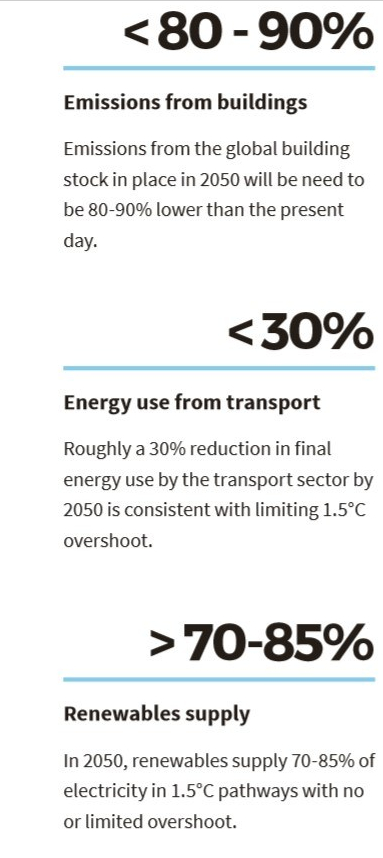
With an increase in growth of population in urban areas would mean lead to an increase in infrastructure on buildings and other land cover, these include:
- Introducing new technologies within buildings and infrastructure which have or near to zero emissions
- Installation of non-structural building elements and thermal insulations
- Decrease in carbon intensity of electricity
- Low carbon levels within transportation sector e.g. pedestrianised cities, zero emissions vehicles
There are of course many benefits from reducing CO2 emissions such as:
- Higher productivity and job creation
- Better health and life expectancy
- Better air quality
- Resilient to extreme events
Urbanisations and its policies must act as a powerful force in transitional the four systems. However, the feasibility factor will play a big part.
Are these changes possible?
The report doesn’t really tell us whether it will be feasible however, it does highlight that not every adaptation or mitigation option can be deployed. As this will depend on environmental, ecological, technological, social and economic factors. The options which are available can be multi-dimensional and can be used simultaneously such as green infrastructure and ecosystem services.
How can we ignite the urban transition?
By achieving the goal of limiting global warming to 1.5° there has to be effective governance framework which will be in participation from cities and urban areas, industry and scientific institutions. The main focus is on technological innovation where we can use artificial intelligence and the ‘internet of things’ to create new initiatives which will help the urban transition within cities. This will also help reduce financial costs within mitigation.
Can we afford this?
There is no actual way of financing all the possible ways of limiting global warming to 1.5°. It is estimated that an average of USD 2.4 trillion between 2016 and 2035 is needed to keep global warmer lower than 1.5°. There are initiatives where government policies can recuperate and encourage mobilisation of private funds by lowering the risk of low emission an adaptation of investments. There is a lot which we need to understand within the climate financing on a city and global level.
What does the future hold?
Climate change and global warming is happening and at a fast rate. We do need to be more sustainable and environmentally friendly and introduce a low carbon footprint in all countries. Being sustainable and using renewables is key and understanding where and how to be sustainable is very important. Urban policy makers play a big role in adapting to climate change and help lower global warming. Cities are the main trigger in adapting to policies to meet this goal. These policies and actions need to be taken with high concern and need immediate action.
We have everything we need to transform and change the system in the direction of a greater sustainability and an environmentally friendly world. We need to take every moment and tackle global warming.
 Dhanik's Blog